My Route & Adventure
Spain is hotting up as one of 2025’s top travel destinations, and with so much to see, why spend your holiday in just one place?
Last year, I took a two-week road trip around Spain, hiring a car and journeying through sun-drenched coastal roads, stunning landscapes, bustling cities, and breathtaking mountain scenes. Over two weeks, I drove over 1,700 kilometres, soaking in the vibrant culture and history that Spain is so well known for.
An spanish road trip adventure around Spain should be on everyone’s travel bucket list, so if you’re looking to ditch the typical tourist hotspots and experience the country to its fullest, here’s my itinerary for the ultimate Spanish road trip!
Days 1 & 2: Madrid – The Heart of Spain.
My journey began in Madrid, the dynamic capital city of Spain.

Getting to Adolfo Suárez Madrid–Barajas Airport from Manchester Airport only took me 2.5 hours, and flights from the UK to Madrid can cost as little as £30 if you book plenty of time before you travel, so getting to my starting point was quick and easy. To get to Madrid city centre, I took the Metro (Line 8 to Nuevos Ministerios), but you can also get the train, using Cercanías C1 and C10 lines to Atocha station.
Arriving in Madrid to begin my spanish road trip felt like being welcomed with open arms. The friendliness of Spanish people, the buzz of the city and the stunning historic architecture had me ready to dive head-first into the rich culture and my awaiting adventures.
My first port of call was to check into a charming adorable hotel near Malasaña, and I soon discovered that Malasaña is quite a trendy, hipster area of Madrid, offering colourful streets lined with cool cafes – the perfect place to begin my wanders.
For the rest of the day, I mostly travelled on foot or using the city’s extensive Metro system – widely considered one of the best in Europe. I love seeing new cities this way – public transport gives you a chance to encounter so many interesting people, and walking always results in stumbling across hidden gems, quaint side streets and quirky cafes that are so easily missed if you only travel by car.
I’m an art lover, so I set aside a few hours to visit the contemporary art in Sala Alcalá 31 and the masterful photography collections in La Fábrica – two of the best art galleries in Madrid. After tucking into my first authentic Spanish Tapas for dinner, I then headed over to the Chueca neighbourhood for a dive into the vibrant LQBTQ+ nightlife in the area.
The following morning, after admittedly nursing a bit of a hangover, I ventured from my hotel room to further my sightseeing in Madrid, this time using the Lime app to rent an e-scooter. The city has some strict regulations on the use of e-scooters, though, so make sure you scrub up on these before you hire one to avoid any issues with police.
I could write an entire article about my spanish road trip and Madrid alone—the city has so much to offer, but instead, here are some highlights:
Top things to do in Madrid
- Temple of Debod – An authentic ancient Egyptian temple in the middle of the city!
- Lavapiés – A neighbourhood spattered with breathtaking street art.
- La Tabacalera – An old tobacco factory turned into an underground art space with an industrial vibe.
- El Retiro Park – The ideal place for a picnic, you can even hire a rowboat here if you’re looking for something a bit different to do.
- Royal Palace of Madrid – Explore opulent rooms and the royal armoury.
Best places to eat in Madrid
- La Oveja Negra – Vegan tapas and Spanish classics.
- Nakama Sushi Bar – Vegan sushi rolls and Asian fusion dishes.
- Mad Mad Vegan – Best for burgers, loaded fries, and all things a little bit naughty.
- Botín – The world’s oldest restaurant with a menu packed with authentic Spanish food.
Day 3: Toledo and Cuenca – Caves and Cliffs
- Distance from Madrid to Toledo: 75 km (1 hour drive)
- Distance from Toledo to Cuenca: 180 km (2 hours drive)

To make the most of my day, I picked up my rental car and left Madrid quite early, heading the short drive south to Toledo – a medieval city perched magnificently on a hilltop. The labyrinthine streets are worth exploring on foot so that you can get a real feel for the rich history the city is steeped in. Toledo is a UNESCO World Heritage Site, so if you’re one for history then this is the place for you!
Deep below Toledo is a network of underground caves, tunnels and crypts, many dating back to Roman and Moorish periods and each boasting its own legend, history, or mystery. I have a secret love for the odd and unnerving, so I obviously had to book a tour to see them for myself.
Once I had my fill of underground exploration, I stopped for lunch near the Tagus River at a place called Restaurante La Ermita, where I dined overlooking the water, before heading on the next leg of the journey.
Hanging Houses – Casas Colgadas.

After eating, I jumped back into my hire car and hit the road, heading east for about two hours to reach Cuenca – a hidden gem famous for its “hanging houses” (Casas Colgadas) that cling to the cliffside.
Toledo is a stunning town, but Cuenca was even more magnificent. The maze of quaint streets, lined with old stone buildings. The Renaissance architecture that popped up here and there. The charming buzz of the traditional Spanish life. If you’re a fan of rugged landscapes Cuenca is an absolute must on your route!

One side of the city sits on the Hoces del Huécar gorge, while the Hoces del Júcar gorge, formed by the Júcar River, runs along the other. Since it was only early afternoon by the time I arrived, I donned my hiking boots and went on one of the many mountain trails that neighbour the town.
I spent the evening soaking in the breathtaking views of the gorge and had an iconic tapas dinner at a small, family-run restaurant before getting my head down for the night. The peace of Cuenca was a stark contrast to Madrid’s bustle, giving me my first taste of the rich and varied experiences that a Spanish road trip has to offer.
Top things to do in Toledo
- Underground Caves & Tunnels: There’s a variety to choose from, and guided tours are available.
- Alcázar of Toledo: A majestic fort that rises high above the city.
- Mirador del Valle Hike: A short but steep hike that will take you to the best views of Toledo.
Top things to do in Cuenca
- Casas Colgadas: Iconic 15th-century houses built onto the hillside.
- Gorge Hikes: Both the Hoces del Júcar and Hoces del Huécar gorges have a variety of stunning hiking trails well worth checking out.
Days 4 & 5: Cuenca to Valencia – A Dip in the Mediterranean
- Distance from Cuenca to Valencia: 200 km (2.5 hours drive)

By day four of my Spanish road trip, I was ready for a true taste of the Mediterranean… the Mediterranean Sea, that is!
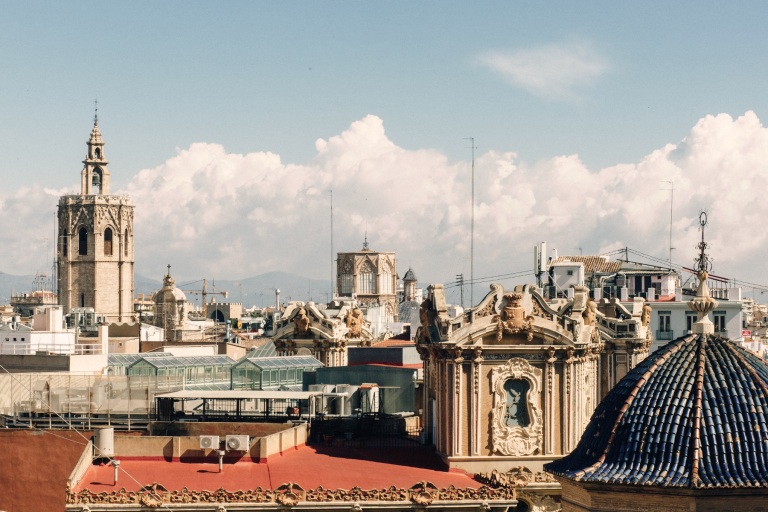
Valencia is Spain’s third-largest city and is a vibrant blend of history, culture, and modern innovation. Nestled on the Mediterranean coast, it boasts stunning architecture, from the contemporary City of Arts and Sciences to the gothic walls of the famous Valencia Silk Exchange.
My first port of call was to grab my bikini and get myself to the beach. Valencia is blessed with an average of 300 days of sunshine a year, so you’re almost guaranteed to have a decent tan after a day or two there.
I headed to Playa de la Malvarrosa, the easiest beach to get to from the town centre. I dropped into one of the beachfront cafes, and pretty quickly made friends with some awesome Aussie girls who I bumped into.

We made a spontaneous (and somewhat ridiculous!) decision to hire some jet skis and go on a tour all the way to Albufera Natural Park, where the waters are crystal clear and the pristine sand dunes gave us a quiet stop to sunbathe before the journey back.
One of my fave things about travelling is the people that you cross paths with – sometimes it’s the locals, sometimes it’s fellow travellers, but always there’s a lot to gain from making memories together!
The girls told me about this little gem of a vegetarian restaurant in Ruzafa – an artsy neighbourhood in Valencia. We agreed to meet up for dinner later that evening, so I dashed back to my hotel to scrub up and get the sand from my hair. As it turned out, the Ruzafa district was closer to my hotel than I realised, so I rented a bike from the hotel lobby and rolled on over.
La Casa Viva, a vegan and vegetarian restaurant, is hailed as one of the best in Valencia. The food is utterly to die for, and the rustic chic decor made it the perfect place to spend the evening.

I had carved two days into my Spanish road trip itinerary to spend in Valencia since the city has so much to offer. It’s a very easy city to navigate and there are extensive cycle lanes, so for my second day there I booked out my bike again and explored on two wheels.
My first stop was Institut Valencià d’Art Modern (IVAM), which took just 15 minutes to cycle from my hotel near Ruzafa. The art gallery houses a decent-sized collection of surrealist pieces and abstract art. It’s not a particularly large gallery, so I only spent an hour or so there, before heading for lunch in the nearby Turia Gardens. Of course, since paella originates from Valencia, I had to make a point of getting an authentic dish from its birthplace while I was there!
Naturally, I had to wrap up my last afternoon in Valencia at the beach, so this time, I headed over to Playa de la Patacona Beach, cycling along the coastal path for some cracking views along the way.
Top things to do in Valencia
- City of Arts and Sciences: A huge culture multiplex that houses an aquarium, a performance centre, and a botanical garden.
- Turia Gardens: A beautifully landscaped garden with a great cycling route.
- Ruzafa District: A trendy neighbourhood with street art, vintage stores, and nightlife – great to explore on foot.
- Valencia Cathedral: A striking gothic cathedral that they say houses the holy grail.
Day 6: Valencia to Alicante – The Heart of Costa Blanca
- Distance from Valencia to Alicante: 165 km (2 hours drive)

Arriving at Alicante took my breath away. The city is a patchwork of colourful houses, with Mount Benacantil rearing up beside it, offering unbeatable views out to the turquoise-blue sea. The quintessential Mediterranean vibes here make exploring on foot an absolute must, with street upon street lined with quaint houses adorned with planters and bright colours.

That being said, one of the key things I wanted to do in Alicante was kayaking and snorkelling in the covens of Cala de la Granadella. I arranged a tour and we headed off in kayaks to a quiet, secluded spot where the crystal clear waters are surrounded by rocky cliff faces.
After over an hour of snorkelling, watching the marine life, and exploring underwater caves, we were about to wrap things up when a copper-coloured octopus came gracefully slinking out of the shadows and right past me. I’ve got to admit – now I want one as a pet!

Back on dry land, I wound down my day watching the sunlight kiss the mountain as it sunk into the sea, then threw on my glad rags, ready to check out Alicante’s notorious nightlife. I knew I had to head to Confetti Alicante – the town’s most famous LGBTQ+ nightclub, where I danced away until the early hours, grateful that the next leg of my journey wouldn’t need an early start!
Top things to do in Alicante
- Santa Bárbara Castle: The most iconic landmark in Alicante, sitting atop the mountain.
- Mirador de la Ereta Hike: A peaceful hike near Santa Bárbara Castle, giving panoramic views of the city.
- El Barrio de Santa Cruz: The old town district—perfect for finding authentic tapas and historical sites.
- Snorkelling & Kayaking: The best place in Spain for octopus-spotting!
Day 7: Alicante to Murcia – The Town with Roman Roots
- Distance from Alicante to Murcia: 80 km (1.5 hour drive)

Before I left Alicante I had a long lie-in to recover from my night out, blowing away the cobwebs by doing the Mirador de la Etra hike and getting some gorgeous shots of the city below.
Around midday, I headed south and a little inland for the next leg of the journey—Alicante to Murcia. A lesser-known but equally as charming stop, Murcia is a spot for those who love history and architecture. However, I had only planned to stay there for one reason: paragliding.

About 35km from the town is Espuña Adventure – an operator that runs evening paragliding adventures that offer panoramic views of the vistas of Alhama de Murcia and the three national parks that surround them.
I know that skydiving is generally a popular way to get a birds-eye view of the world, but paragliding is a much more eco-friendly way to take flight, so I got to enjoy the sky without feeling the guilt. If you’re a bit of an adrenaline junkie, then this is absolutely a must-do on your Spanish road trip!
Days 8 & 9: Murcia to Granada – Architecture and Achey Legs
- Distance from Murcia to Granada: 270 km (3 hours drive)

Fun fact: in 2024, Granada was voted as the least walkable city in Europe! Exploring on foot is always a preference, but be warned, almost everywhere is uphill from anywhere—I was definitely glad I packed my hiking boots because this is not a city to explore in flip-flops!
The city itself feels like something straight out of a Mediterranean storybook, with narrow cobbled streets, a fortress nestled into the hillside and the sleepy vibe that Spanish cities are known for. After the adventure-filled few days I had just had, I gave myself two days to wind down in Granada.
On my first evening, I walked from my hotel across to the Sacromonte neighbourhood, which is famous for its traditional cave dwellings and flamenco performances. Here, I had a mind-blowing vegan dish called escalivada in a restaurant in one of the cave houses before getting into the lively world of flamenco dancing.
For my second day, in all honesty, there isn’t too much to write about; I simply took it easy and enjoyed the scorching sun, sitting outside a charming cafe with my nose in a book.
Top things to do in Granada
- Sacromonte cave dwellings: The array of traditional cave houses on the hillside.
- Live Flamenco Show: Impressive performances in intimate cave settings.
- Albaicín district: The historical district with a Moroccan twist.
- Alhambra: A famous Spanish landmark; a hilltop palace complex with lush gardens.
Days 10 & 11: Granada to Seville – Towers and Tapas
- Distance from Granada to Seville: 250 km (3 hours drive)

Seville was next on my itinerary, and from the moment I arrived, I fell in love with its energy. Seville is known for its ancient towers, so once I had parked up at my hotel, I headed off on a guided cycling tour of the city, which took me on an in-depth ride into the city’s history, including a visit to the top of the Giralda Tower, where I got some incredible views of the city.
After three hours of cycling around Seville, I headed for lunch at Mercado de Triana – the traditional Spanish Market, where the bustling stalls offer a taste of the local produce and the freshest food. I opted for a quieter afternoon, taking the chance to wander the city at my own pace and check out the Real Alcázar of Seville – a stunning Moorish palace with intricate architecture.

That evening, I headed out for—you guessed it—more tapas… I can easily admit that I’m now a little addicted to Spanish food! Once I was stuffed full of patatas bravas, I decided to head to the rooftop bar on the insane wooden structure Metropol Parasol, to get a night-time view of Seville, lit up like a fairytale castle.
I had left the next day open with the idea of winging it, but after meeting some fellow tourists as we enjoyed the evening cityscape, I agreed to something a little bit off-piste for day eleven of my road trip…
We met up the next afternoon to clown around in Museo de las Ilusiones for a few hours before our ghost tour of Seville—yep, you read that right! I’m very much a sceptic, but I have to admit, snooping around some of Seville’s creepiest historical sites, listening to famous phantom stories, and trying out ghost-hunting equipment did send a shiver down my spine once or twice!
Top things to do in Seville
- Cycling tours: A gentle way to explore the city
- Museo de las Ilusiones: An immersive art gallery dedicated to optical illusions – great for getting some novelty snaps!
- Plaza de España: A historical plaza with stunning architecture
- Ghost tour: Definitely a unique way to see the sights!
Day 12: Seville to Córdoba – The City of Timeless Charm
- Distance from Seville to Córdoba: 140 km (1.5 hours drive)

Córdoba made sense as the final stop on my road trip around Spain before my return to Madrid. The charming, sleepy town felt like the perfect place to chill for a day before heading back to hustle and bustle of Spain’s capital city.
I wandered through Patios de Córdoba where the walls are covered with planters full of vibrant flowers, through Judería (Jewish Quarter), getting lost in its narrow, whitewashed streets, and to Mezquita-Catedral, with its mesmerizing red-and-white arches.
Finally, I settled near Puente Romano (Roman Bridge) by the Guadalquivir River to overindulge in paella and finally finish my book, making a mental note to find a decent paella recipe as soon as I get home.
Sightseeing in Córdoba offers some unique and outstanding scenes, perfect for some stunning photos and a quiet day of meandering on foot.
Days 13 & 14: Back to Madrid – The End of the Adventure
- Distance from Córdoba to Madrid: 400 km (4.5 hours drive)

After driving over 1700km and totting up more than 20 hours behind the wheel, my two-week road trip around Spain brought me back to where it all began—Madrid. By the time I arrived back, I had a day and a half left in the city, so I had to make it count!
After I had dropped my rental car off at the depot, I took the metro to Playa de Madrid, an artificial beach that gave me one last chance to get sand between my toes. Though of course not a patch on the real thing, it was the perfect way to unwind after the 4.5-hour drive.
I made the most of my final day in Madrid by cramming in all of the things I hadn’t had the time to do when I first arrived, including Temple of Debod, La Tabacalera, and El Retiro Park.
And just like that, it was all over. I managed to visit nine cities on my two-week road trip around Spain. I met some fantastic people, had some weird and wonderful experiences, and soaked in both the sun and the sea, but as they say, all good things must come to an end. There’s still so much more of Spain that I haven’t seen, so I will definitely be back… my tapas addiction demands it!

Final Thoughts
If you’re considering visiting Spain, I’d easily recommend making your holiday a road trip. The country has so many amazing landscapes and such a rich culture that staying in just one place would see you missing out. If you want your dream Spanish road trip without the headache of planning it, following my road trip itinerary will give you a well-rounded, authentic Spanish adventure without the hassle!
I got my trip – now get yours! x
Anna
gotmytrip pages contain affiliate links, which means I may earn a commission if you click through and make a purchase—at no extra cost to you. I only recommend products and services that I genuinely believe in. Your support helps keep this site running. Thanks, Anna!

Incredible Warm Winter Holidays: The Top 8 Places in Europe for an Escape to the Sun
Best Digital Nomad Cities for 2025
From Masters to Modern: Top Art Galleries in Amsterdam and The Hague