A Two-week Guide to New Delhi, Agra and Jaipur
Whats In the Article
India’s Golden Triangle
India’s world-famous Golden Triangle is an unforgettable travel route that flows through three of the country’s most historic cities: New Delhi, Agra and Jaipur.
Rich with culture and boasting some of the most recognisable architecture in the world, including The Taj Mahal. The route is a treasure trove of discovery for travellers and packed with historical sites. For those wanting to dig deep into India’s rich heritage, The Golden Triangle is a must-have on your itinerary.
Of course, tourists can opt to travel the route in any order, but since the main international airport along the way is in New Delhi, most travellers start their adventure there. There are also relatively easy-to-navigate routes by train, which is by far the cheapest way to travel The Golden Triangle and tends to be a popular choice for backpackers. We opted to make the route a two-week road trip, allowing us to get a view of the scenery from the ground.
So, here’s how we took our north Indian road trip.

Driving in India
You can drive in India if you hold an International Driving Permit (IDP), which is valid for up to one year, with cars available to hire in many places throughout the city. However, driving in India is not for the faint-hearted—the roads can be chaotic, traffic rules aren’t particularly well-followed and signage is understandably rarely in English. We opted to hire local drivers to make our time on the road easier, however, here are the main airports for those wanting an easier journey and reduced travel time:
Nearest Airports Along the Golden Triangle Route
- New Delhi: Indira Gandhi International Airport (DEL)
- Agra: Pandit Deen Dayal Upadhyay Airport (AGR) (Primarily a military base, limited civilian flights available and mostly only takes domestic flights, meaning that Agra isn’t the best place to start the route.)
- Jaipur: Jaipur International Airport (JAI)
Days 1-4: New Delhi – India’s Vibrant Capital

We started off in India’s capital city, New Delhi, home to several UNESCO World Heritage Sites and a true taste of modern India. The city is a vibrant blend of modernity and tradition, with bustling streets bursting with colourful bazaars, decadent restaurants and iconic landmarks. Of course, in the midst of New Delhi, there is also Old Delhi, which is home to some of the more historical monuments and is a portion of the city that needs to be on your agenda. Our time in New Delhi was the perfect way to start our adventure around The Golden Triangle route, giving us a taste of life in modern India.
Must-Visit Landmarks in New Delhi:

Red Fort
Old Delhi’s recognisable red stone fort and a stunning example of ancient Mughal architecture, built for the Indian royal family in 1639 when the capital was moved from Agra to Delhi.
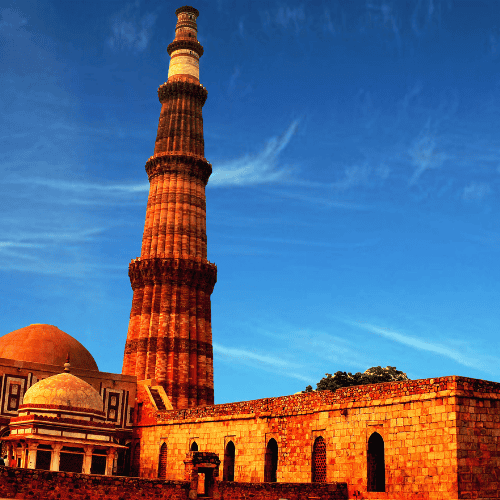
Qutub Minar
The tallest brick minaret in the world, also known as the ‘Victory Tower’ and an iconic part of New Delhi’s skyline.

India Gate
A monument dedicated to the roughly 70,000 Indian soldiers who died in World War I.

Humayun’s Tomb
An architectural precursor to the Taj Mahal with its famous domed roof, and the burial site for around 150 members of the Mughal family.
We enjoyed a busy four days exploring India’s capital, with our local guide giving us an in-depth history of the importance of the landmarks that nestle within New Delhi’s charming chaos. While we were there, we also took a walking tour around some of the world-famous marketplaces, where we tried street foods, picked up souvenirs and learned how to barter.
Next, we took the four-hour drive through the endless desert-like countryside to the next stop on our Golden Triangle adventure: Agra.
Days 5-9: Agra – Home of the Majestic Taj Mahal

Officially classed as a medieval city, Agra was founded in the year 1504 and is home to one of the world’s most iconic landmarks – The Taj Mahal. Agra is generally a lot calmer than New Delhi, making exploring it on foot much easier. We gave ourselves four days here, making sure we didn’t need to rush any of the most iconic scenes in Northern India. Our local guide took to to The Taj Mahal for sunrise, letting us witness the monument glitter as dawn bounced off the marble mausoleum.
Must-Visit Landmarks in Agra:

Agra Fort
A massive 16th-century red stone fort that offers iconic views of the Taj Mahal and is located on the Yamuna River.

Fatehpur Sikri
The mostly deserted city that was once the Mughal capital, rich with a blend of Mughal and Hindi architecture and intricately carved red sandstone.

Itimad-ud-Daulah
The first tomb in India constructed entirely of white marble and spectacular mosaic designs.

Taj Mahal
A UNESCO World Heritage Site and classed as one of the New Seven Wonders of the World. Famously, Princess Diana was photographed sitting on one of the marble benches in front of the monument, making it one of the most recreated photographs in history.
A trip to India could not be complete without a visit to Agra and The Taj Mahal. Not only is the site one of the most iconic experiences imaginable, but it is a firm favourite on the bucket list of many travellers worldwide, pulling in up to eight million tourists a year.
Getting there for sunrise is usually the best time of day to visit The Taj Mahal if you want to avoid the crowds and the heat of the day, letting you explore the grounds free from interruption. It’s also a great idea to hire a tour guide to ensure that you get a full understanding of the powerful history of what is widely considered the world’s most famous symbols of love and commitment.
When our time in Agra came to an end, we hit the road once more, driving five hours to the final city on our Indian road trip: Jaipur.
Days 10-14: Jaipur – The Pink City

We gave ourselves four days in Jaipur, the capital of the state of Rajasthan, which gave us just enough time to fit in what we had planned. Since the city is generally a lot more slow-paced than New Delhi and Agra, exploring it on foot gave us a chance to really soak up the sights.
On our first day there, we went on a walking tour with a local guide, who talked us through the history of Jaipur. It is easy to see why it is also known as ‘The Pink City‘, with huge terracotta-coloured forts, palaces and historical buildings, painted so in 1876 by the maharaja to celebrate a visit from the British royal family.
Jaipur is home to some of India’s most amazing feats of architecture, including the most accurate pre-modern observatory in the world.
Jaipur is home to some of India’s most amazing feats of architecture, including the most accurate pre-modern observatory in the world. There is also a fort at the top of a huge hill, however, many tourists make the trip up the hill on the backs of elephants. While a ride on an elephant might sound fun, a visit to the stables taught us that many of the animals are kept in poor conditions when they are not working long hours ferrying tourists, so I’d suggest using a different mode of transport such as a rickshaw or hired car.
Must-Visit Landmarks in Jaipur:

Amber Fort Palace
A massive hilltop palace complex in which the maharajahs lived. The fort is widely considered to be Jaipur’s main tourist attraction and overlooks the stunning lake Maota. A clear highlight of a tour around the fort is the famed Hall of Mirrors, where intricate designs made from thousands of mirrors are embedded into the marble walls.

Hawa Mahal
The iconic ‘Palace of Winds’ boasts over nine hundred intricately carved windows, forming the most recognisable of Jaipur’s pink buildings.

Jantar Mantar
Another of India’s UNESCO World Heritage Sites, the observatory is said to be accurate to within 2 seconds, local time. The huge 3D structures also track the placements of the planets and follow astronomical positioning.

Arts & Crafts Tour
A walking tour that shows you some of Jaipur’s famous arts, giving you an in-depth education of the hand creation of iconic crafts such as rug weaving, fabric block printing and intricate decorative marble works.
Other Things to Do on The Golden Triangle Route
In each city, there is so much more to do than only see the key historical sites. India is well known for its unique and vibrant culture, so in between our visits to the landmarks we spent our evenings seeing belly dancers, watching traditional puppet shows, trying our hand at making Indian cuisine with cookery classes and meeting local people who taught us all about the history of the areas they call home. There is a total of eight UNESCO World Heritage Sites along The Golden Triangle route, giving architecture and history fans some must-see sights.

For those who like a walk on the wild side, Agra is home to The Taj Nature Walk, providing a hike through India’s natural forest with breathtaking views of the Taj Mahal. About an hour’s drive from Agra City is the Agra Bear Rescue Facility, where roughly one hundred sloth bears that have been rescued from the cruel bear-dancing tourist attractions now live a peaceful life.

Where to Stay Along the Way
Since The Golden Triangle is such an iconic route that attracts millions of tourists a year, each city is packed with hotels and hostels for all price ranges. Whether you’re looking for luxury and a rooftop pool or something more low-key with exciting nightlife, there are hundreds of options for travellers.
Our personal favourite was treating ourselves to an indulgent stay at Shahpura House in Jaipur, which was once a palace for the royal family with decadent rooms and stunning traditional design. Usually, we take a more humble approach to our travels, but we couldn’t pass up the opportunity to experience a few nights in a palace!

When to Visit India
Top Tips for Travelling India

- Keep cash handy – India is still very much a cash economy, so keeping some rupees safe about your person to pay in smaller shops and rural areas and to provide tips for services is wise.
- Remember to tip – Tipping is customary in India and supports lower-income workers such as drivers, porters and waiting staff.
- Dress conservatively – Modest dress is valued by locals, so keeping shoulders, legs and chest covered is key, especially in rural areas or near religious sites.
- Carry a water bottle – The heat can get pretty intense during the hotter months, but always ensure that you drink filtered or bottled water, avoid ice in drinks and check that purchased water bottles are sealed.
- Choose food wisely – Avoid the infamous ‘Delhi Belly’ stomach upsets by ensuring that food is fresh. A smart move is to avoid salads and seafood if you aren’t sure of the source and be certain that street food is thoroughly cooked.
- Stay connected – Navigating a different country can be tricky, so purchase an eSIM to help with maps, translations and staying connected.

- Travel with an app – Download a transport app such as Namma Yatri or Ola to book rickshaws safely and avoid being ripped off.
- In an emergency – The number for emergency services in India is 112 and will connect you to the local police, fire department or urgent care health services.
Conclusion

The Golden Triangle is an iconic part of the Indian travel experience, with its vibrant cities and immersive tours. Taking in the world-famous historical sites and unique culture of the country along the route promises travellers an unforgettable dive into the traditions and heritage that India is known for. There’s a clear reason for this celebrated route to be the top priority for those exploring the India, making our two-week road trip undeniably a highlight of our travels.
Keen on travelling The Golden Triangle?
For the best deals on flights, hotels and experiences, use gotmytrip.com
gotmytrip pages contain affiliate links, which means I may earn a commission if you click through and make a purchase—at no extra cost to you. I only recommend products and services that I genuinely believe in. Your support helps keep this site running. Thanks Anna!